ChatGPT for doctors
Built for clinical questions only.Every answer cited.
That is what colleagues call Standard Medicine. You type a clinical question and get an answer in seconds, built from local and European guidelines and peer-reviewed papers, with a numbered citation on every statement. Free for healthcare professionals.



 EuropeanGuidelines
100,000+ clinical questions asked across 48 specialties.
ChatGPT and Standard Medicine
A general assistant, and a tool built for one job.
ChatGPT
Anything
OpenAI's general assistant, built for every task: drafting, coding, summarising, answering questions on any subject. Answers come from a general language model, with web search in some modes. Clinical questions are one use among many.
Standard Medicine
Medicine
Built for clinical questions from healthcare professionals. Searches local and European guidelines and the peer-reviewed literature, then writes an answer where every statement links to its source. Free, and you can ask in your own language.
Side by side
Checked 6 November 2026.
| Side by side | ChatGPT | Standard Medicine |
|---|---|---|
| Built for | Any task, any user | Clinical questions from healthcare professionals |
| Answers are built from | A general language model, with web search in some modes | Local and European guidelines, and journals indexed in PubMed and Europe PMC |
| Citations | On request, or in search mode | A numbered citation on every statement, with title, authors, journal, year and DOI |
| The text you type | On consumer plans, conversations can be used to train models unless you turn that off | Used to answer your question. Patient information must not be entered |
| Price | Free tier; Plus at USD 20 a month | Free for healthcare professionals |
| Made by | OpenAI, San Francisco, United States | Standard Medicine AB, Stockholm, Sweden |
ChatGPT is a product of OpenAI. Facts about it come from OpenAI's own pages on the date above. Standard Medicine has no relationship with OpenAI.
A clinical question, answered
Captured from the product, unedited. Every number has a source.
How does myocardial infarction present differently in women?
In international sources, chest pain, tightness, or pressure remains the predominant presenting symptom of myocardial infarction in both women and men, occurring in over 80% to 90% of cases 123. However, notable sex-specific presentation patterns are described:
- Higher burden of accompanying symptoms: Women present with a greater total number of non-chest symptoms and are significantly more likely to present with a cluster of ≥3 associated symptoms 24. These commonly include epigastric discomfort, nausea, vomiting, shortness of breath, palpitations, fatigue, dizziness, and referred pain to the jaw, neck, upper back, shoulder, or arms 256.
- Presentations without chest pain: Women are more likely than men to present entirely without chest pain across cohort studies and registries (for example, 37% versus 27% in pooled cohorts 7, and an adjusted odds ratio of 1.51 in young ST-elevation MI 2), as described in international sources 273.
- Symptom phenotype variability: Women display significantly greater variation in unique symptom combinations and presentations than men, which contributes to diagnostic delays, attribution of symptoms to non-cardiac causes (such as anxiety or acid reflux), and lower rates of timely reperfusion, according to international sources 238.
References
- 1Presenting Symptoms in Men and Women Diagnosed With Myocardial Infarction Using Sex-Specific Criteria.Ferry AV, Anand A, Strachan FE, et al.. J Am Heart Assoc. 2019. doi:10.1161/JAHA.119.012307
- 2Sex Differences in the Presentation and Perception of Symptoms among Young Patients with Myocardial Infarction: Evidence from the VIRGO StudyLichtman JH, Leifheit EC, Safdar B, et al.. Circulation. 2018. doi:10.1161/CIRCULATIONAHA.117.031650
- 3Sex and gender in cardiovascular medicine: presentation and outcomes of acute coronary syndrome.Haider A, Bengs S, Luu J, et al.. Eur Heart J. 2020. doi:10.1093/eurheartj/ehz898
- 4State of the Science: The Relevance of Symptoms in Cardiovascular Disease and Research: A Scientific Statement From the American Heart Association.Jurgens CY, Lee CS, Aycock DM, et al.. Circulation. 2022. doi:10.1161/CIR.0000000000001089
- 5Call to action for acute myocardial infarction in women: international multi-disciplinary practical roadmap.Manzo-Silberman S, Hawranek M, Banerjee S, et al.. Eur Heart J Open. 2024. doi:10.1093/ehjopen/oeae087
- 6Symptoms of Infarction in Women: Is There a Real Difference Compared to Men? A Systematic Review of the Literature with Meta-AnalysisCardeillac M, Lefebvre F, Baicry F, et al.. J Clin Med. 2022. doi:10.3390/jcm11051319
- 7Acute coronary syndromes in women and men.Pagidipati NJ, Peterson ED. Nat Rev Cardiol. 2016. doi:10.1038/nrcardio.2016.89
- 8Sex Differences in Symptom Phenotypes among Patients with Acute Myocardial InfarctionBrush JE, Krumholz HM, Greene EJ, et al.. Circ Cardiovasc Qual Outcomes. 2020. doi:10.1161/CIRCOUTCOMES.119.005948


Built in Stockholm by doctors and engineers. About us
Compare Standard Medicine with
Mobile app
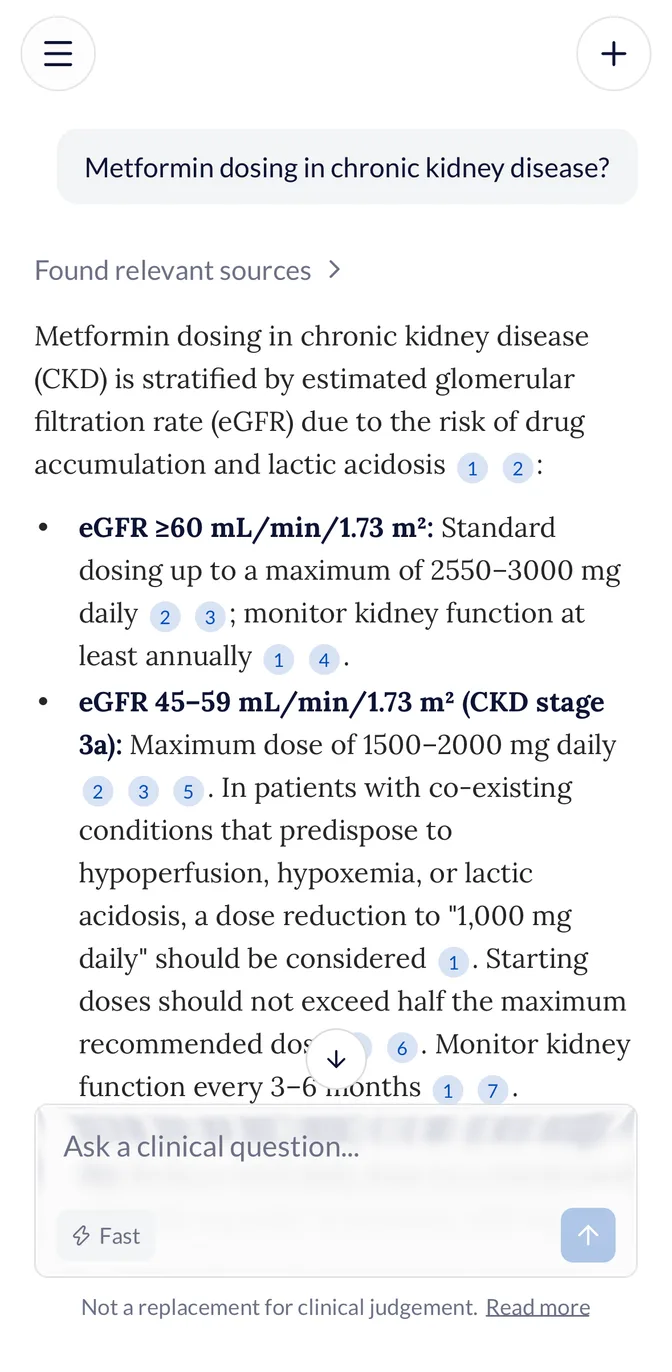
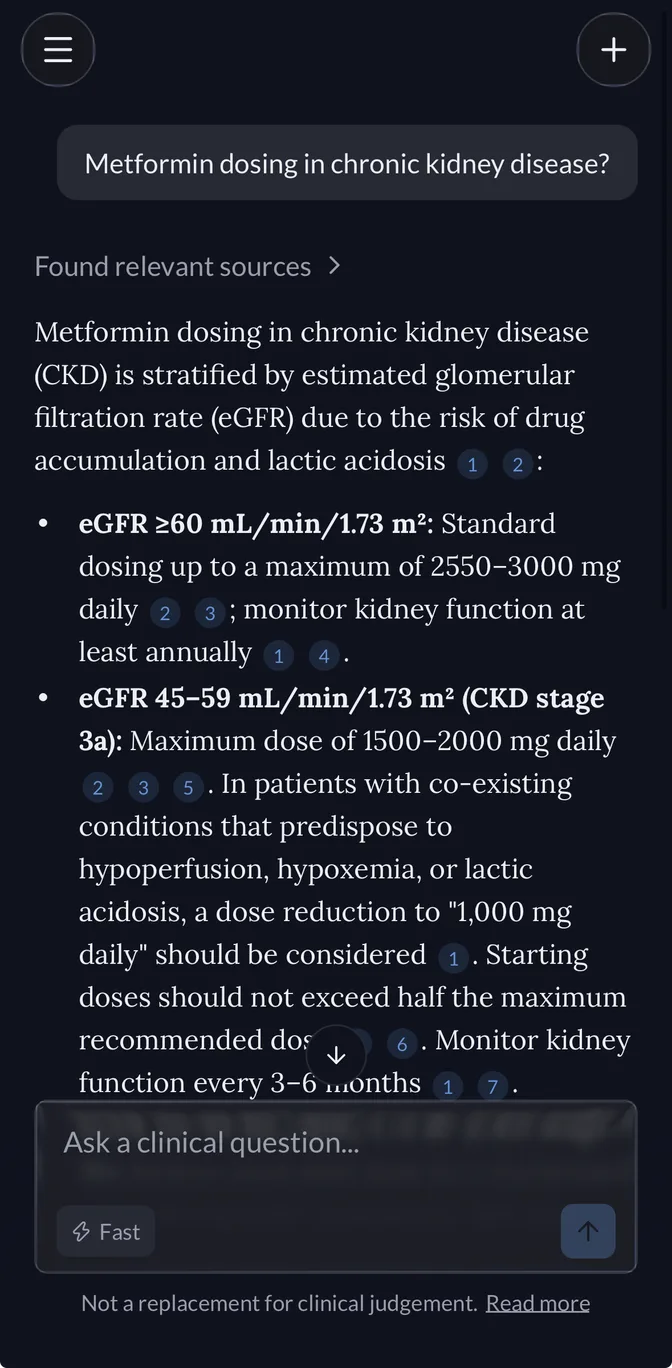
Evidence in your pocket
Between patients, on the ward, in clinic.The same sourced answers, on your phone.Free for healthcare professionals.



Common questions
When should I use Standard Medicine instead of ChatGPT?
When the answer has to rest on a guideline or a paper you can open and read, when the question depends on local guidelines, and when you want every statement traceable to its source. Keep ChatGPT for drafting a letter or explaining a concept.
Is there a ChatGPT for doctors in Europe?
OpenAI launched ChatGPT for Clinicians in April 2026 for US users. At the date above, OpenAI's own pages do not list the UK or the EEA as supported regions. Standard Medicine is free for healthcare professionals in any country.
Does Standard Medicine use ChatGPT?
Standard Medicine runs its own search over medical sources and uses large language models to write the answer from what the search found. The answer is limited to those sources, and every statement links back to one of them.