Guideline search
Evidence-based search for guideline questions.Every answer cited.
Standard Medicine is a free, evidence-based AI search tool for doctors. Ask a guideline question and get a cited answer that draws on European and national clinical guidelines alongside the published literature.



 EuropeanGuidelines
100,000+ clinical questions asked across 48 specialties.
A guideline question, answered
Captured from the product, unedited. Every number has a source.
Guideline criteria for diagnosing heart failure with preserved ejection fraction?
According to international guidelines, the diagnosis of heart failure with preserved ejection fraction (HFpEF) universally requires three core components: typical clinical symptoms and signs of heart failure, a preserved left ventricular ejection fraction (LVEF ≥50%), and objective evidence of cardiac structural or functional alterations indicative of left ventricular (LV) diastolic dysfunction or elevated LV filling pressures 123.
Biochemical criteria rely on elevated natriuretic peptides, typically defined as NT-proBNP >125 pg/mL (or ≥125 ng/L) or BNP >35 pg/mL (or ≥35 ng/L) in sinus rhythm, whereas higher thresholds are applied in atrial fibrillation (>365 pg/mL for NT-proBNP; >105 pg/mL for BNP) or acute presentations, as described in international sources 145.
Structural and functional parameters on resting transthoracic echocardiography are evaluated to establish diastolic dysfunction, in line with international guidelines 145:
- Structural markers: Left atrial volume index (LAVI) >34 mL/m² in sinus rhythm or >40 mL/m² in atrial fibrillation; LV mass index (LVMI) ≥95 g/m² in women or ≥115 g/m² in men; and relative wall thickness (RWT) >0.42 145.
- Functional Doppler indices: Average E/e' ratio >9 to ≥15 at rest, septal e' velocity <7 cm/s, lateral e' velocity <10 cm/s, tricuspid regurgitation (TR) velocity >2.8 m/s, or estimated pulmonary artery systolic pressure >35 mmHg 164.
When resting non-invasive parameters yield diagnostic uncertainty, formalized multivariable clinical scoring systems or stress testing are utilized in international sources 27:
- HFA-PEFF score: A stepwise algorithm assessing functional, morphological, and biomarker criteria; a total score ≥5 points establishes HFpEF, ≤1 point makes it unlikely, and intermediate scores (2–4 points) warrant functional exercise testing or invasive hemodynamics 625.
- H₂FPEF score: A 0–9 point clinical model based on obesity (BMI >30 kg/m²; 2 points), ≥2 antihypertensives (1 point), atrial fibrillation (3 points), pulmonary hypertension (PASP >35 mmHg; 1 point), age >60 years (1 point), and elevated filling pressure (E/e' >9; 1 point), where a score ≥6 indicates a high probability of HFpEF 628.
- Hemodynamic confirmation: Invasive cardiac catheterization demonstrates elevated filling pressures with resting pulmonary capillary wedge pressure (PCWP) ≥15 mmHg, resting LV end-diastolic pressure ≥16 mmHg, or exercise PCWP ≥25 mmHg 49.
References
- 1Heart failure with preserved ejection fraction management: a systematic review of clinical practice guidelines and recommendations.Mahmood A, Dhall E, Primus CP, et al.. Eur Heart J Qual Care Clin Outcomes. 2024. doi:10.1093/ehjqcco/qcae053
- 2Heart failure with mildly reduced and preserved ejection fraction: A review of disease burden and remaining unmet medical needs within a new treatment landscape.Desai N, Olewinska E, Famulska A, et al.. Heart Fail Rev. 2024. doi:10.1007/s10741-024-10385-y
- 3Integration of imaging and circulating biomarkers in heart failure: a consensus document by the Biomarkers and Imaging Study Groups of the Heart Failure Association of the European Society of Cardiology.Moura B, Aimo A, Al-Mohammad A, et al.. Eur J Heart Fail. 2021. doi:10.1002/ejhf.2339
- 4Heart failure with preserved ejection fraction: diagnosis, risk assessment, and treatment.von Haehling S, Assmus B, Bekfani T, et al.. Clin Res Cardiol. 2024. doi:10.1007/s00392-024-02396-4
- 5Controversies and dilemmas in the diagnosis of heart failure with preserved ejection fraction.Prasad SB, Holland DJ, Atherton JJ. Med J Aust. 2023. doi:10.5694/mja2.52053
- 6Diagnosis of heart failure with preserved ejection fraction: a systematic narrative review of the evidence.Formiga F, Nuñez J, Castillo Moraga MJ, et al.. Heart Fail Rev. 2023. doi:10.1007/s10741-023-10360-z
- 7The diagnosis and subclassification of heart failure with preserved ejection fraction: a review.Creegan D, Starling RC, Hameed A, et al.. Heart Fail Rev. 2026. doi:10.1007/s10741-026-10618-2
- 8Heart Failure with Preserved Ejection Fraction in Egypt: An Expert Opinion.Abdelhamid M, Salem AZ, Kabil H, et al.. Glob Heart. 2025. doi:10.5334/gh.1411
- 9Effectiveness and safety analysis of Qifu Yixin Prescription for the treatment of heart failure with preserved ejection fraction: study protocol for a randomized, double-blind, placebo-controlled clinical trial.Xu Z, Hu Y, Yang J, et al.. BMC Complement Med Ther. 2025. doi:10.1186/s12906-025-05106-3
Ask it the way you would ask a colleague
Plain-language questions about diagnosis, risk scores, guideline thresholds, trial evidence and management, typed the way you would say them.
Every statement carries a citation
Answers are built from peer-reviewed literature, European guidelines and national guidelines. Each claim is numbered, and the reference list shows title, authors, journal and DOI.
A search tool. The judgement is yours.
Standard Medicine finds and summarises what is published, with every source one click away. The clinical decision stays with you.


Built in Stockholm by doctors and engineers. About us
What colleagues are saying
“I find Standard Medicine a smooth way to get quickly from ‘I should know this’ to a structured, clinically useful overview. I use SM both in my everyday work with patients and to go deeper into areas I come across less often.”
“Easy to use and good. I use it in my everyday clinical work to find relevant, reliable information.”
Mobile app
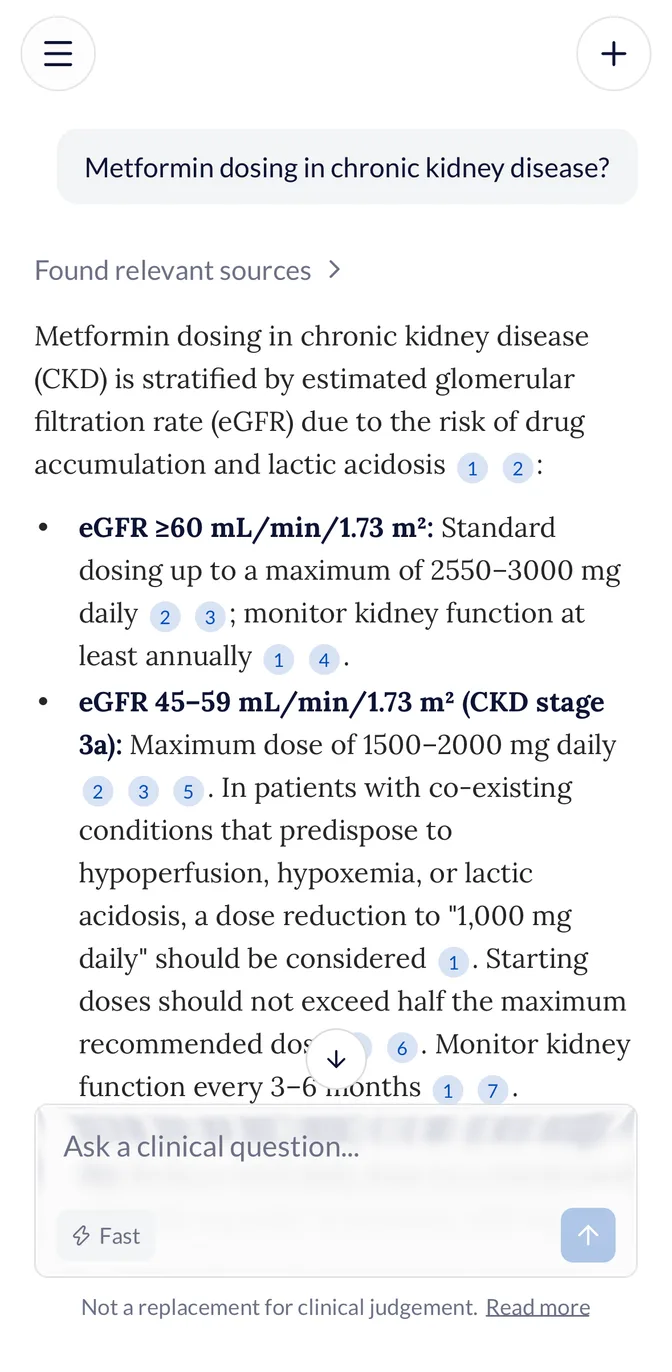
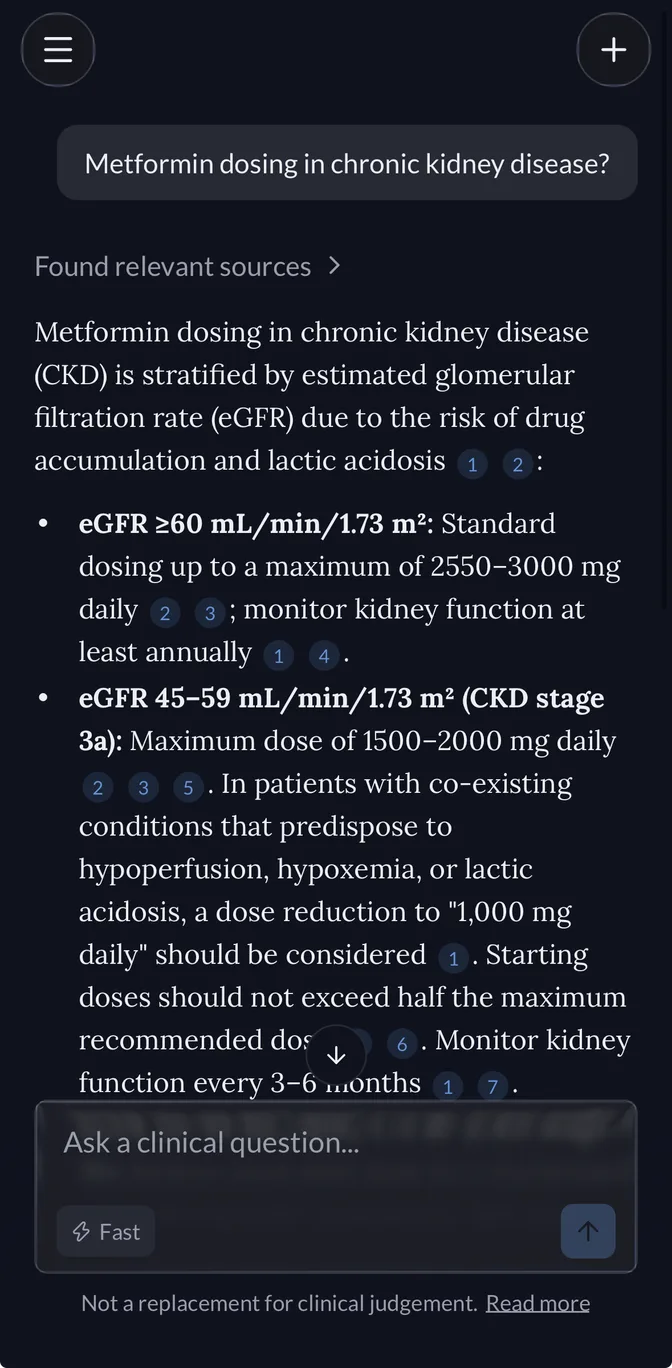
Evidence in your pocket
The guideline answer, with the guideline cited, wherever you are.The same sourced answers, on your phone.Free for healthcare professionals.



Common questions
Is there a free AI tool for searching clinical guidelines?
Standard Medicine is free for verified healthcare professionals. Ask your first guideline question straight away, then create a free account to keep going.
Which guidelines does Standard Medicine search?
Standard Medicine searches peer-reviewed journals indexed in PubMed and Europe PMC, European clinical guidelines and national guidelines. Every answer lists its references with title, authors, journal, year and DOI.
How is Standard Medicine different from ChatGPT for guideline questions?
Standard Medicine attaches a citation to every statement and links to the guideline it comes from, so you can read each recommendation in context.
Do I need an account or an EHR integration to use Standard Medicine?
Standard Medicine runs in the browser and as an iPhone and Android app, separate from your patient record. Ask your first question straight away, in general clinical terms, and create a free account to keep going.
How do I check an answer from Standard Medicine?
Every claim in a Standard Medicine answer carries a numbered citation. Click it to open the source. The reference list at the end of the answer shows every paper and guideline used.
Can I use Standard Medicine in my own language?
Yes. Standard Medicine is available in English, Swedish, Danish, Norwegian, Finnish, Icelandic, French and Portuguese, and you can ask in your own language.