Literature search
Evidence-based search for published research.Every answer cited.
Standard Medicine is a free, evidence-based AI search tool for doctors. Ask about a trial, a systematic review or the evidence for a treatment and get an answer from the published literature, with a citation on every statement.



 EuropeanGuidelines
100,000+ clinical questions asked across 48 specialties.
A question about the evidence, answered
Captured from the product, unedited. Every number has a source.
What is the evidence for the HINTS exam versus early MRI in acute vertigo?
According to international sources, the bedside HINTS examination (Head Impulse, Nystagmus, Test of Skew) demonstrates higher sensitivity for detecting acute posterior circulation stroke than early diffusion-weighted MRI (MRI-DWI) during the initial 24–48 hours of an acute vestibular syndrome (AVS). In pooled analyses, early MRI-DWI carries a false-negative rate of approximately 12% to 20% (pooled sensitivity 85.1% [95% CI 79.2–91.0]), as microscopic diffusion restriction in small brainstem or cerebellar infarcts may lag behind physiological neuro-otological dysfunction.
When evaluated in patients with continuous vertigo and nystagmus, bedside HINTS demonstrates an aggregate sensitivity of 94.0% to 95.3% (95% CI 92.5–98.1) and specificity of 86.9% to 92.6% (95% CI 88.6–96.5), as described in international sources. The addition of bedside hearing assessment to create "HINTS Plus" improves sensitivity further (up to 95.7%–99.2%) by capturing anterior inferior cerebellar artery (AICA) territory infarctions that spare the vestibulo-ocular reflex or mimic peripheral lesions.
The diagnostic accuracy of HINTS is strongly operator-dependent in line with international sources. When performed by specialist neuro-otologists or neurologists, sensitivity reaches 94.3%–96.7% and specificity reaches 94.8%–97.6%. In general emergency department cohorts involving non-subspecialists, diagnostic accuracy declines substantially (pooled sensitivity 83% [95% CI 63–95] and specificity 44% [95% CI 36–51]), frequently resulting from testing unselected episodic or positional dizziness rather than true continuous AVS with nystagmus.
Ask it the way you would ask a colleague
Plain-language questions about diagnosis, risk scores, guideline thresholds, trial evidence and management, typed the way you would say them.
Every statement carries a citation
Answers are built from peer-reviewed literature, European guidelines and national guidelines. Each claim is numbered, and the reference list shows title, authors, journal and DOI.
A search tool. The judgement is yours.
Standard Medicine finds and summarises what is published, with every source one click away. The clinical decision stays with you.


Built in Stockholm by doctors and engineers. About us
What colleagues are saying
“I find Standard Medicine a smooth way to get quickly from ‘I should know this’ to a structured, clinically useful overview. I use SM both in my everyday work with patients and to go deeper into areas I come across less often.”
“Easy to use and good. I use it in my everyday clinical work to find relevant, reliable information.”
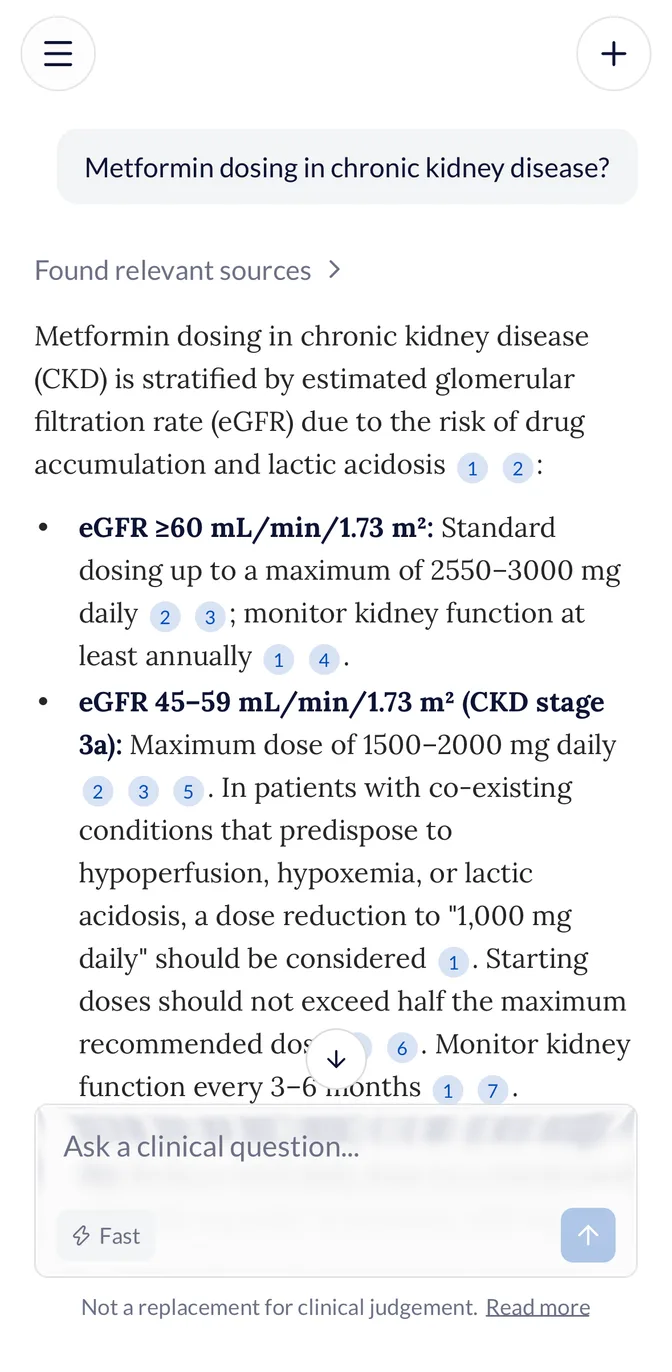
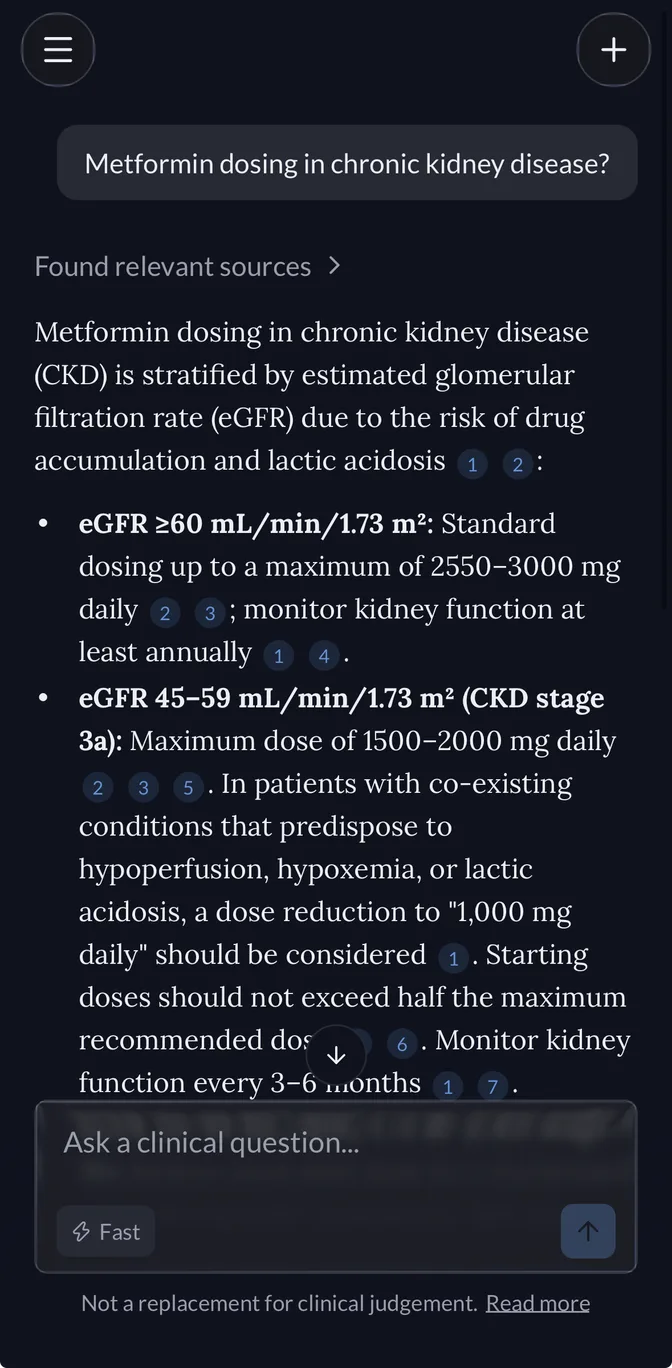
Mobile app
Evidence in your pocket
The paper behind the answer, one tap away, wherever you are.The same sourced answers, on your phone.Free for healthcare professionals.



Common questions
Is there a free AI tool for literature searches?
Standard Medicine is free for verified healthcare professionals. Ask your first question about the evidence straight away, then create a free account to keep going.
Which literature does Standard Medicine search?
Standard Medicine searches peer-reviewed journals indexed in PubMed and Europe PMC, European clinical guidelines and national guidelines. Every answer lists its references with title, authors, journal, year and DOI.
How is Standard Medicine different from ChatGPT for literature questions?
Standard Medicine searches the published literature for your question, attaches a citation to every statement and links to the paper, so you can read it yourself.
Do I need an account or an EHR integration to use Standard Medicine?
Standard Medicine runs in the browser and as an iPhone and Android app, separate from your patient record. Ask your first question straight away, in general clinical terms, and create a free account to keep going.
How do I check an answer from Standard Medicine?
Every claim in a Standard Medicine answer carries a numbered citation. Click it to open the source. The reference list at the end of the answer shows every paper and guideline used.
Can I use Standard Medicine in my own language?
Yes. Standard Medicine is available in English, Swedish, Danish, Norwegian, Finnish, Icelandic and French, and you can ask in your own language.